W10. Relations and Graphs
1. Theory
1.1 Introduction to Relations
A relation is a fundamental concept in mathematics that describes how elements from different sets are connected or associated with each other. Formally, any subset of a Cartesian product of sets is called a relation. If we have sets
Relations can have different arities (number of elements involved). A unary relation (arity 1) describes a property of individual elements, like “x is positive” or “a person is a woman.” A binary relation (arity 2) connects pairs of elements, such as “x is less than y” or “person x is married to person y.” Higher-arity relations involve three or more elements, like “x + y = z” connecting three numbers.
1.1.1 Binary Relations
A binary relation
For example, the relation “less than or equal to” on natural numbers
1.2 Properties of Binary Relations
Binary relations can have various important properties that characterize their behavior. Understanding these properties is crucial for classifying relations and studying their applications.
1.2.1 Reflexivity and Irreflexivity
A relation
Conversely, a relation is irreflexive (also called anti-reflexive) if no element is related to itself:
Important: A relation can be neither reflexive nor irreflexive. For instance, “person x likes person y” may hold for some people with themselves but not others.
1.2.2 Symmetry, Asymmetry, and Anti-symmetry
A relation
A relation is asymmetric if whenever
A relation is anti-symmetric if whenever both
Key distinction: Asymmetric implies anti-symmetric AND irreflexive, but anti-symmetric does not imply asymmetric.
1.2.3 Transitivity
A relation
Examples of transitive relations:
- “Less than” (<): if
- “Equals” (=): if
- “There is a path from city x to city y”: if there’s a path from x to y and from y to z, there’s a path from x to z
Examples of non-transitive relations:
- “x + y = 0”: if
- “x is a friend of y”: friends of friends are not necessarily friends
1.2.4 Connexity
A relation
The relation “is a friend of” is not connex because two people might not be friends in either direction.
1.3 Representations of Binary Relations
Binary relations can be represented in multiple ways, each offering different insights.
1.3.1 Matrix Representation
For a relation
This representation makes properties visually apparent:
- Reflexive: All 1s on the main diagonal
- Irreflexive: All 0s on the main diagonal
- Symmetric: Matrix equals its transpose (
- Anti-symmetric: If
- Connex: For
1.3.2 Graph Representation
A relation can be visualized as a directed graph (digraph) where:
- Vertices (nodes) represent elements of the set
- Directed edges (arcs, arrows) represent the relation: an arrow from
- Loops (self-loops) at a vertex represent reflexive pairs
Graph properties:
- Reflexive: Loop at every vertex
- Irreflexive: No loops at any vertex
- Symmetric: For every edge from
- Asymmetric: Never two edges in opposite directions between distinct vertices
- Transitive: If there’s an edge from
- Connex: Between any two distinct vertices, at least one directed edge exists
1.4 Counting Relations on Finite Sets
For a finite set
1.4.1 Total Number of Relations
Any binary relation on
1.4.2 Reflexive Relations
For a reflexive relation, all
1.4.3 Irreflexive Relations
Similarly, for irreflexive relations, all
1.4.4 Symmetric Relations
For a symmetric relation, if
- Diagonal elements:
- Off-diagonal elements:
Total:
1.4.5 Asymmetric Relations
For asymmetric relations, diagonal elements must all be 0 (irreflexive). For off-diagonal pairs
Total:
1.4.6 Anti-symmetric Relations
For anti-symmetric relations:
- Diagonal elements:
- Off-diagonal pairs: For each pair
Total:
1.4.7 Transitive Relations
Counting transitive relations is extremely difficult — no simple closed formula exists. The count grows much more slowly than
1.5 Special Types of Relations
1.5.1 Partial Order Relations
A strict (partial) order is a binary relation that is:
- Irreflexive:
- Asymmetric:
- Transitive:
Example: “Less than” (<) on numbers.
A non-strict (partial) order is a binary relation that is:
- Reflexive:
- Anti-symmetric:
- Transitive:
Example: “Less than or equal to” (
Relationship: A non-strict order can be obtained from a strict order by adding equality:
An example of a partial order that’s not immediately obvious: For vectors in
1.5.2 Linear Order Relations
A linear order (also called total order) is a non-strict partial order that is also connex:
- Reflexive:
- Anti-symmetric:
- Transitive:
- Connex:
Example: “Less than or equal to” (
For a set with
1.5.3 Equivalence Relations
An equivalence relation is a binary relation that is:
- Reflexive:
- Symmetric:
- Transitive:
Common notations for equivalence relations:
Examples:
- Equality (=) on any set
- “Has the same cardinality as” for sets:
- “Has the same age as” for people (counting only years)
- “Is logically equivalent to” for logical formulas:
Equivalence Classes: An equivalence relation partitions the set into disjoint subsets called equivalence classes. An equivalence class is a maximal set of elements that are all equivalent to each other. For any element
Main Property: Two equivalence classes are either identical or disjoint — they cannot partially overlap. This means an equivalence relation creates a partition of the set into non-overlapping groups.
1.6 Graph Theory Basics
1.6.1 Terminology
The field of graph theory has varied terminology across different texts and contexts. Frank Harary, a pioneer in graph theory, noted that “even the very word ‘graph’ has not been sacrosanct” and recommended that speakers clarify their terminology in advance.
A directed graph (digraph) is essentially equivalent to a binary relation. Common alternative terms:
| Mathematical Term | Graph Theory Terms |
|---|---|
| Elements | Vertices, nodes, points |
| Relations | Edges, arcs, lines, links |
1.6.2 Properties in Graph Language
All the relation properties we’ve discussed can be expressed in graph-theoretic terms:
- Reflexive: Loop at every vertex
- Irreflexive: No loops
- Symmetric: Bidirectional edges between all connected vertices
- Asymmetric: No bidirectional edges (all edges are one-way)
- Transitive: If there’s an edge
- Connex: Between any two distinct vertices, at least one directed edge exists
2. Definitions
- Relation: Any set
- Binary Relation: A set
- Reflexive: A relation
- Irreflexive (Anti-reflexive): A relation
- Symmetric: A relation
- Asymmetric: A relation
- Anti-symmetric: A relation
- Transitive: A relation
- Connex (Total, Complete): A relation
- Strict Partial Order: A relation that is irreflexive, asymmetric, and transitive.
- Non-strict Partial Order: A relation that is reflexive, anti-symmetric, and transitive.
- Linear Order (Total Order): A relation that is reflexive, anti-symmetric, transitive, and connex.
- Equivalence Relation: A relation that is reflexive, symmetric, and transitive.
- Equivalence Class: For an equivalence relation
- Directed Graph (Digraph): A visual representation of a binary relation with vertices (elements) connected by directed edges (arrows).
3. Formulas
- Total Number of Binary Relations on
- Number of Reflexive Relations on
- Number of Irreflexive Relations on
- Number of Symmetric Relations on
- Number of Asymmetric Relations on
- Number of Anti-symmetric Relations on
- Number of Linear Orders on
- Asymmetric Relation Equivalence: A relation is asymmetric if and only if it is both anti-symmetric and irreflexive.
- Matrix Element Definition: For relation
- Non-strict from Strict Order:
4. Practice
4.1. Line Crossing Relation (Lab 8, Task 1a)
Consider the relation “line
Click to see the solution
- Reflexive? Does a line cross itself?
- Answer: No — a line doesn’t cross itself.
- Irreflexive? Does no line cross itself?
- Answer: Yes — no line crosses itself.
- Symmetric? If line
- Answer: Yes — crossing is mutual.
- Asymmetric? If line
- Answer: No — crossing is symmetric, not asymmetric.
- Anti-symmetric? If line
- If two lines cross each other, they cross each other (symmetric), but they’re not the same line.
- Answer: No — distinct lines can cross.
- Transitive? If line
- Counterexample: Three lines meeting at a point, where line 1 crosses line 2, line 2 crosses line 3, but lines 1 and 3 are parallel (don’t cross).
- Answer: No — not transitive.
- Connex? For any two lines, does one cross the other?
- Counterexample: Parallel lines don’t cross.
- Answer: No — parallel lines exist.
Answer: Irreflexive and symmetric only.
4.2. “Greater by 2” Relation (Lab 8, Task 1b)
Consider the relation “number
Click to see the solution
The relation is:
- Reflexive? Is
- Answer: No — never true.
- Irreflexive? Is
- Answer: Yes — always true.
- Symmetric? If
- If
- Answer: No — not symmetric.
- If
- Asymmetric? If
- Yes, if
- Answer: Yes — asymmetric.
- Yes, if
- Anti-symmetric? If
- The premise is impossible (would require
- Answer: Yes — vacuously true.
- The premise is impossible (would require
- Transitive? If
- From
- Answer: No — not transitive.
- From
- Connex? For any two natural numbers
- Counterexample: For
- Answer: No — not connex.
- Counterexample: For
Answer: Irreflexive, asymmetric, and anti-symmetric.
4.3. Divisibility Relation (Lab 8, Task 1c)
Consider the relation “number
Click to see the solution
- Reflexive? Is every number divisible by itself?
- Answer: Yes —
- Answer: Yes —
- Irreflexive? Is no number divisible by itself?
- Answer: No — every number is divisible by itself.
- Symmetric? If
- Counterexample:
- Answer: No — not symmetric.
- Counterexample:
- Asymmetric? If
- Counterexample:
- Answer: No — not asymmetric.
- Counterexample:
- Anti-symmetric? If
- If
- This gives
- Answer: Yes — anti-symmetric.
- If
- Transitive? If
- If
- Answer: Yes — transitive.
- If
- Connex? For any two natural numbers
- Counterexample:
- Answer: No — not connex.
- Counterexample:
Answer: Reflexive, anti-symmetric, and transitive (it’s a non-strict partial order).
4.4. Matrix Properties (2) (Lab 8, Task 2)
For each of the following matrices, determine the properties of the corresponding relation on set
(Matrix 1)
(Matrix 2)
(Matrix 3)
(Matrix 4)
Click to see the solution
Matrix 1:
- Reflexive? Diagonal:
- Irreflexive? Has 1s on diagonal — No
- Symmetric? Check if
- Asymmetric? Has reflexive pairs — No
- Anti-symmetric? Check pairs with both directions = 1:
- No such pairs exist for distinct elements — Yes
- Transitive? Check all
- Connex? Check all distinct pairs:
Answer for Matrix 1: Reflexive and anti-symmetric.
Matrix 2:
- Reflexive? Diagonal:
- Irreflexive? All diagonal elements are 0 — Yes
- Symmetric? Check if
- Yes — symmetric
- Asymmetric? Has bidirectional edges — No
- Anti-symmetric? Has pairs with both directions = 1 for distinct elements — No
- Transitive?
- Connex? No reflexive pairs, so not connex — No
Answer for Matrix 2: Irreflexive and symmetric.
Matrix 3:
- Reflexive? Diagonal:
- Irreflexive? — No
- Symmetric?
- Asymmetric? Has reflexive pairs — No
- Anti-symmetric? No bidirectional pairs for distinct elements — Yes
- Transitive?
- Check
- Row 2 =
- Check
- Connex?
Answer for Matrix 3: Reflexive and anti-symmetric.
Matrix 4:
- Reflexive? Diagonal:
- Irreflexive? — No
- Symmetric?
- Asymmetric? — No
- Anti-symmetric? Check:
- Transitive? Many violations — No
- Connex? Element 2 and 4 not self-related — No
Answer for Matrix 4: None of the standard properties.
4.5. Graph Properties from Diagrams (Lab 8, Task 3)
For each of the nine directed graphs shown (with vertices {1, 2, 3}), determine which are reflexive, symmetric, and transitive.
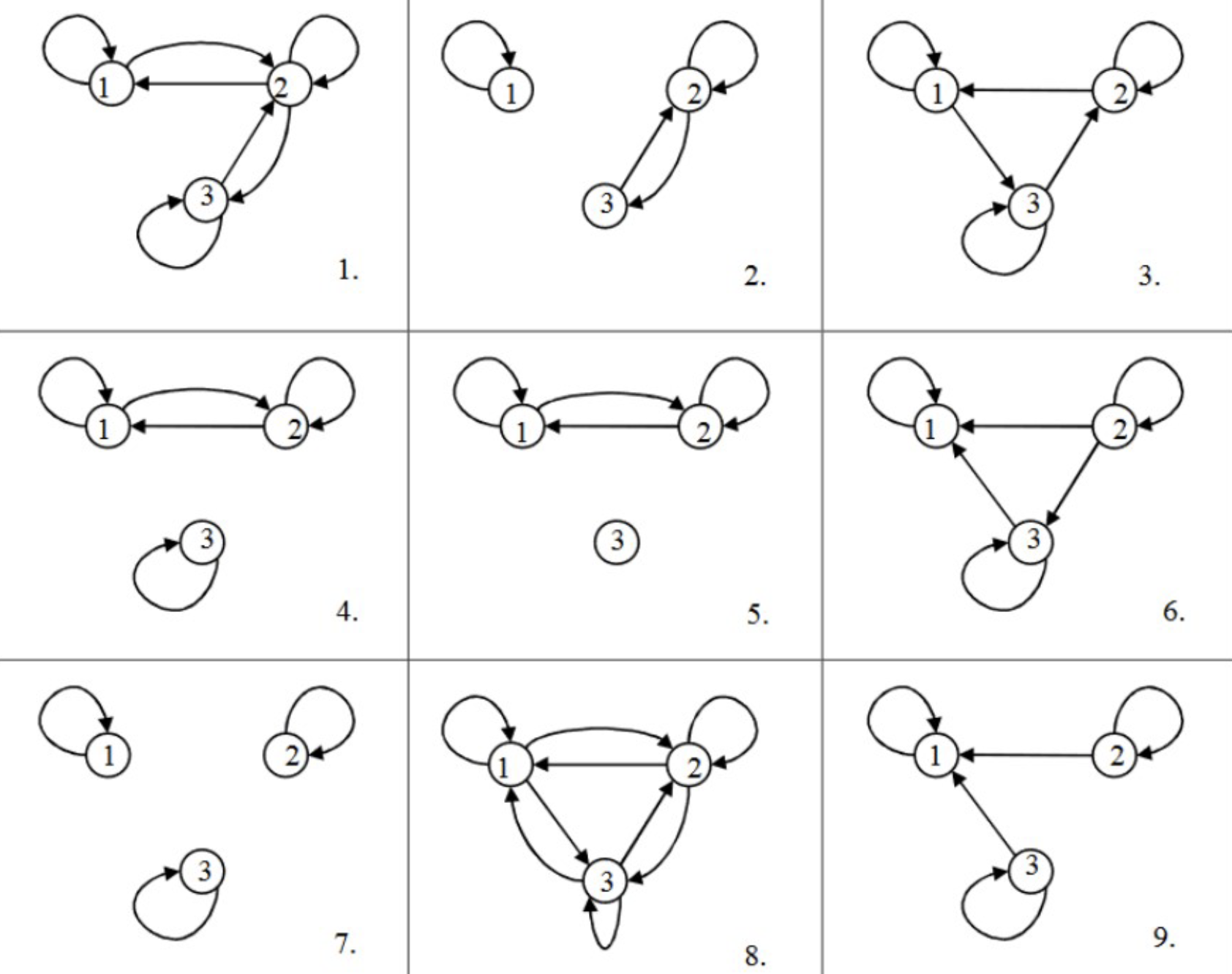
Click to see the solution
We write R for reflexive, S for symmetric, and T for transitive.
- Graph 1
- Every vertex has a loop
- For each edge between distinct vertices (1–2 and 2–3) the reverse edge is also present
- There is a path
- Conclusion: R, S, not T.
- Every vertex has a loop
- Graph 2
- Vertex 3 has no loop
- The only non‑loop edges are between 2 and 3 in both directions, so every edge has its reverse
- From
- Conclusion: S, not R, not T.
- Vertex 3 has no loop
- Graph 3
- Every vertex has a loop
- Around the triangle the edges go in one direction only, so some edges do not have their reverses
- For example,
- Conclusion: R, not S, not T.
- Every vertex has a loop
- Graph 4
- Every vertex has a loop
- Between 1 and 2 we have edges both ways, and there are no edges between
- This is exactly the equivalence relation with classes
- Conclusion: R, S, T.
- Every vertex has a loop
- Graph 5
- Vertex 3 has no loop
- Between 1 and 2 we have edges in both directions, and there are no other non‑loop edges
- Any composable pair of edges starts and ends within
- Conclusion: S, T, not R.
- Vertex 3 has no loop
- Graph 6
- Every vertex has a loop
- Between each pair of distinct vertices we have edges in both directions, so every edge has its reverse
- This is the universal relation on
- Conclusion: R, S, T.
- Every vertex has a loop
- Graph 7
- Only loops, one at each vertex, so every vertex is related to itself
- Every edge is of the form
- Any composable pair
- Conclusion: R, S, T.
- Only loops, one at each vertex, so every vertex is related to itself
- Graph 8
- Every vertex has a loop
- For each edge between distinct vertices, the reverse edge is also present
- Whenever there is a path
- Conclusion: R, S, T.
- Every vertex has a loop
- Graph 9
- Every vertex has a loop
- There are edges
- Any composable non‑loop pair starts at 1 and ends at 1, 2, or 3; all necessary compositions already appear (e.g., from
- Conclusion: R, T, not S.
- Every vertex has a loop
4.6. “Father of” Relation Properties (Tutorial 8, Task 1)
Let
Click to see the solution
Key Concept: Check each property definition against the real-world meaning of the relation.
- Reflexive?
- This would mean every person is their own father.
- Answer: No — this is clearly false.
- Irreflexive?
- This means no person is their own father.
- Answer: Yes — this is true.
- Symmetric?
- This would mean if
- Answer: No — children are not fathers of their fathers.
- This would mean if
- Asymmetric?
- This means if
- Answer: Yes — this is true (the relation only goes in one direction).
- This means if
- Anti-symmetric?
- Since the premise
- Answer: Yes — vacuously true.
- Since the premise
- Transitive?
- This would mean if
- But this describes grandfather, not father.
- Answer: No — grandfathers are not fathers.
- This would mean if
- Connex?
- This would mean for any two people, one is a father of the other.
- Answer: No — most pairs of people have no father-child relationship.
Answer: Irreflexive, asymmetric, and anti-symmetric.
4.7. Matrix Relation Properties (1) (Tutorial 8, Task 2)
Consider a relation
Determine all properties of this relation.
Click to see the solution
- Reflexive? Check the main diagonal:
- Diagonal elements:
- Answer: No — not all diagonal elements are 1.
- Diagonal elements:
- Irreflexive? Check if all diagonal elements are 0.
- Diagonal has
- Answer: No — at least one diagonal element is 1.
- Diagonal has
- Symmetric? Check if
- Answer: No — matrix is not symmetric.
- Asymmetric? Check if whenever
- Answer: No — has a reflexive pair.
- Anti-symmetric? Check if
- For all off-diagonal pairs where
- Answer: Yes — no two distinct elements have bidirectional relation.
- For all off-diagonal pairs where
- Transitive? Check if
- Check all other combinations…
- Answer: Yes — all transitivity conditions are satisfied.
- Connex? Check if for all
- The definition requires
- For
- Checking diagonal elements:
- Since elements 2 and 3 don’t relate to themselves, the relation is not connex.
- Answer: No — not all elements satisfy
- The definition requires
Answer: Yes for anti-symmetric and transitive; No for all others.
4.8. Graph Relation Properties (Tutorial 8, Task 3)
Consider the directed graph with vertices
Click to see the solution
- Reflexive? Check if every vertex has a loop.
- Answer: No
- Irreflexive? Check if no vertex has a loop.
- Answer: No
- Symmetric? Check if every edge has a reverse edge.
- Edge
- Answer: No
- Edge
- Asymmetric? Check if no two distinct vertices have edges in both directions, AND no loops.
- There’s a loop at
- Answer: No
- There’s a loop at
- Anti-symmetric? Check if there are no bidirectional edges between distinct vertices.
- No two distinct vertices have edges in both directions
- Answer: Yes
- Transitive? Check if
- All transitivity conditions satisfied
- Answer: Yes
- Connex? Check if between any two distinct vertices, at least one directed edge exists. Also need all elements to be self-related.
- Elements
- Answer: No
- Elements
Answer: Anti-symmetric and transitive only.
4.9. Total Number of Relations (Tutorial 8, Task 4)
What is the number of all binary relations on a set with
Click to see the solution
Key Concept: A binary relation on a set
- Count total pairs: For a set with
- Count subsets: Any binary relation is a subset of
Answer:
4.10. Number of Reflexive Relations (Tutorial 8, Task 5)
What is the number of all reflexive relations on a set with
Click to see the solution
Key Concept: For reflexive relations, all diagonal elements are fixed (must be included), but other elements are free to choose.
- Fixed elements: All
- Free elements: The remaining
- Count possibilities: For the
Answer:
4.11. Number of Irreflexive Relations (Tutorial 8, Task 6)
What is the number of all irreflexive relations on a set with
Click to see the solution
Key Concept: For irreflexive relations, all diagonal elements are fixed (must be excluded), reasoning is similar to reflexive case.
- Fixed elements: All
- Free elements: The remaining
- Count possibilities:
Answer:
4.12. Number of Symmetric Relations (Tutorial 8, Task 7)
What is the number of all symmetric relations on a set with
Click to see the solution
Key Concept: For symmetric relations, if we include
- Diagonal elements: Each of the
- Off-diagonal elements: For
- Total count:
Answer:
4.13. Number of Asymmetric Relations (Tutorial 8, Task 8)
What is the number of all asymmetric relations on a set with
Click to see the solution
Key Concept: Asymmetric relations are both anti-symmetric and irreflexive. For each unordered pair of distinct elements, we have 3 choices.
- Diagonal elements: All must be excluded (irreflexive), so no choice:
- Off-diagonal pairs: For distinct elements
- Include
- Include
- Include neither
- Include
- Total count:
Answer:
4.14. Number of Anti-symmetric Relations (Tutorial 8, Task 9)
What is the number of all anti-symmetric relations on a set with
Click to see the solution
Key Concept: Anti-symmetric means we cannot have both
- Diagonal elements: Each of the
- Off-diagonal pairs: For each unordered pair of distinct elements
- Include
- Include
- Include neither There are
- Include
- Total count:
Answer:
4.15. Number of Transitive Relations (Tutorial 8, Task 10)
What is the number of all transitive relations on a set with
Click to see the solution
Key Concept: There is no simple closed formula for counting transitive relations. The count depends heavily on
The source material provides a table of values:
| Elements ( |
Any Relations | Transitive | Reflexive | Symmetric |
|---|---|---|---|---|
| 1 | 2 | 2 | 1 | 2 |
| 2 | 16 | 13 | 4 | 8 |
| 3 | 512 | 171 | 64 | 64 |
| 4 | 65536 | 3994 | 4096 | 1024 |
| ??? |
Answer: No simple formula exists. For small
4.16. Number of Linear Orders (Tutorial 8, Task 11)
What is the number of all linear orders on a set with
Click to see the solution
Key Concept: A linear order on a finite set corresponds to a complete ordering (permutation) of the elements.
A linear order must be reflexive, anti-symmetric, transitive, and connex. The connexity property means every pair of distinct elements must be comparable — one must be “less than or equal to” the other.
For
Answer: